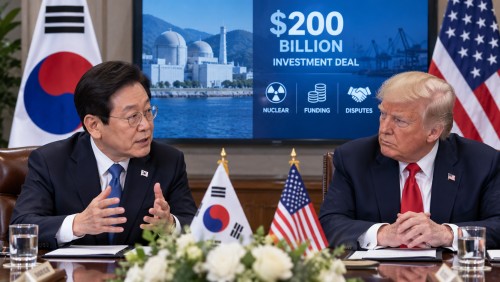
Efforts to finalize a $200 billion investment agreement between South Korea and the United States remain in flux as both countries grapple with significant disagreements over nuclear projects, funding schedules, and investment risks. These complications have cast uncertainty over the framework of South Korea’s financial commitments to the U.S.
A primary sticking point in the negotiations is the selection of nuclear reactor designs. The proposal involves constructing eight reactors in the U.S., with six using Westinghouse’s AP1000 design and two based on South Korea’s APR1400 technology. However, U.S. officials and Westinghouse have opposed the inclusion of the APR1400, complicating the finalization of the nuclear package. South Korea has signaled it may allocate $120 billion of its investment towards nuclear-related initiatives.
Ownership stakes in Westinghouse further complicate matters, as South Korea seeks a 15% to 20% stake along with voting rights and a board seat. Westinghouse, however, aims to limit South Korea’s stake to less than 10%. This disparity in ownership aspirations highlights the challenges in reaching a consensus.
Beyond nuclear projects, South Korea’s involvement in processing spent nuclear fuel and a proposed liquefied natural gas project in Alaska are also on the negotiation table. Concerns about construction costs and long-term returns have made these discussions more complex.
Another significant point of contention is the funding schedule. The U.S. has requested over $9 billion from South Korea by year’s end, while South Korea had planned a more gradual investment approach, starting with smaller contributions in 2026 and increasing from 2027.
Investment returns and losses calculation methods are also debated. South Korea prefers a model where profits from successful projects offset losses from unsuccessful ones, while the U.S. advocates for separate calculations. Under current discussions, the U.S. would retain 90% of net profits post-recovery of principal and interest, a structure that raises concerns for South Korea.
Despite these challenges, negotiations continue as both governments strive to resolve their differences. South Korea’s Industry Ministry has confirmed that discussions are ongoing and that no final decisions have yet been reached regarding the investment package’s specifics.